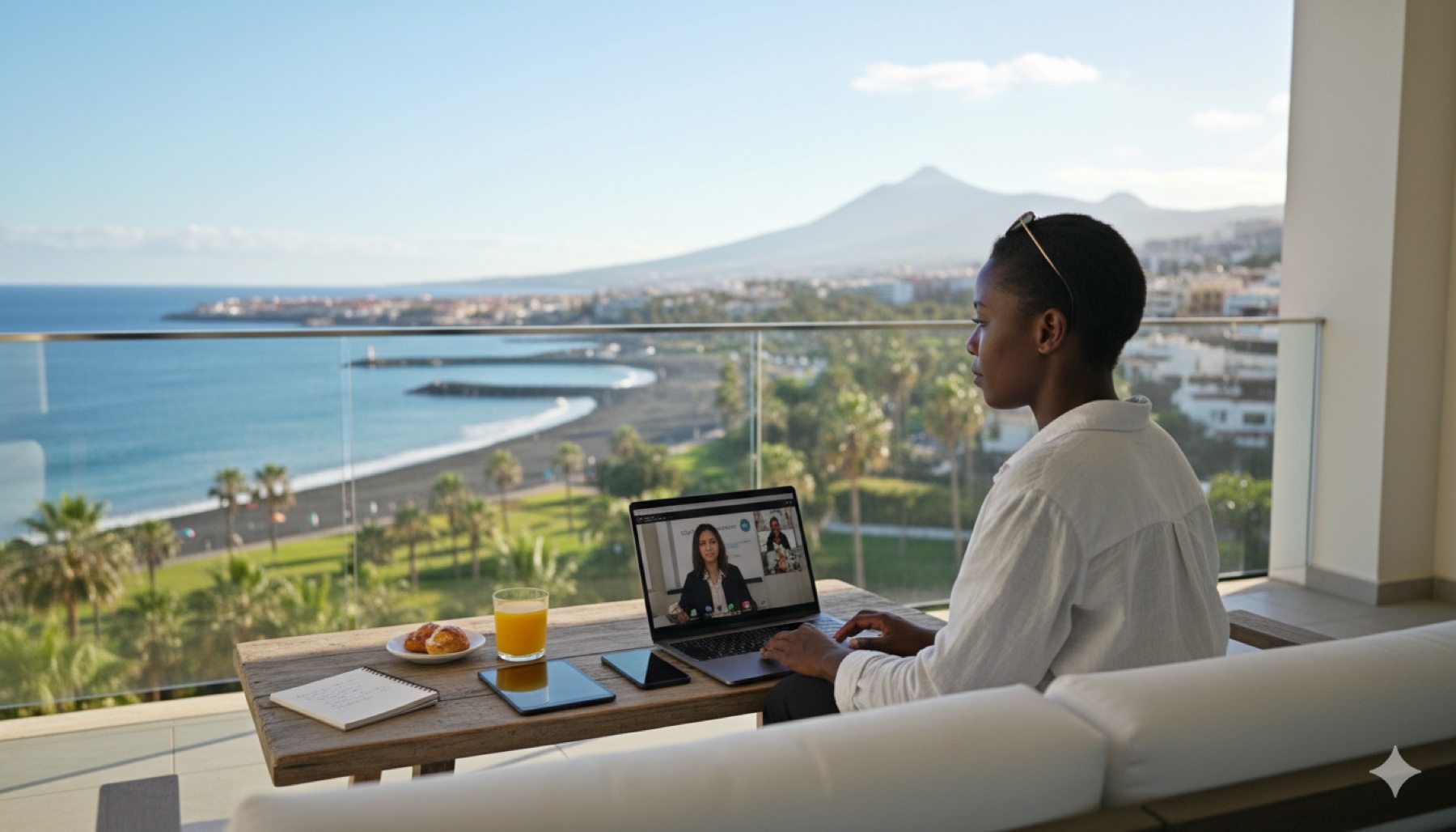
Workation sounds like working where others go on vacation. What counts for tax purposes is whether costs are incurred professionally, clearly documented and separated from private expenses.
Workation sounds like working where others go on vacation - but what about the tax? In this article you will find out when your Workation is tax deductible and what pitfalls you should be aware of.
01What is a workation – and why is the tax treatment so complicated?
A workation is the combination of location-independent work and vacation, for example two weeks in Spain, including several days or weeks in the home office or coworking space.
For tax purposes, the term “Workation” does not exist – the rules for home office, business trips, work rooms and international tax law apply here.
02Short answer: Is a workation tax deductible?
Yes, certain costs of a workation can be tax deductible - but only if they are clearly motivated by work and are clearly separated from private expenses.
- In particular, employees can claim the home office allowance and individual advertising expenses.
- Self-employed people can deduct significantly more costs as business expenses, but they have to calculate private contributions carefully.
- If you stay abroad for a longer period of time, there is a risk of international tax traps and possibly a tax liability in the country in which you work.
03Workation & Taxes for employees
03Question 1: As an employee, can I deduct my Workation from my taxes?
In many cases, a workation is considered to be a private matter - which is why travel, accommodation and meals are generally not deductible as business expenses.
The situation is different if your employer organizes a clearly professional trip, for example an offsite, a seminar or an internal conference with a fixed program.
03Question 2: Which costs are realistically deductible?
- Home office flat rate: Up to 6 euros per day, a maximum of 1,260 euros per year if you mainly work from home - even from a vacation apartment or co-living, provided you do not go to your first place of work.
- Work equipment: Laptop, headset, monitor or desk accessories, if used professionally.
- phone & Internet: Adequate professional portion of your rates (e.g. 50%), ideally documented.
03Question 3: When is the Workation treated like a business trip?
If your activity takes place as part of a business-related trip, such as training or a team event, the normal business travel rules apply: travel to and from the trip, accommodation, additional meal expenses and seminar costs can then be taken into account as business expenses.
However, if you extend the trip privately or book the trip primarily because of the vacation, the tax office can reduce or completely reject the deduction for business expenses.
Tip: If you want to plan your Workation better, take a look at our article “Where in Spain Workation by season?” - there you will find suitable locations depending on the month.
04Tax deductions for self-employed professionals
04Question 4: Which Workation costs are deductible for the self-employed?
For self-employed people, professionally incurred Workation costs are considered business expenses - as long as the business purpose is the main focus.
- Proportionate accommodation costs during working days.
- Coworking space, meeting rooms and, if necessary, day passes.
- Travel costs to customer meetings, workshops or conferences.
- Work equipment as well as telephone and internet costs with a professional component.
04Question 5: How do I separate private and professional costs?
Tax advisors recommend splitting it up pro rata: For example, if you work 10 days and go on vacation for 4 days, 10 out of 14 days of accommodation can be considered a business expense - the rest remains private.
To do this, keep a simple diary with working and vacation days and keep all invoices digitally.
04Question 6: Can I also use the home office flat rate on Workation?
Yes, self-employed people can also claim the home office allowance of up to 1,260 euros per year as a business expense if they work predominantly from a specific location and do not use any other business premises.
Alternatively, with appropriate proof, a home office can be setup with prorated rent and additional costs - this is particularly interesting if you not only work on Workation, but also predominantly work remotely.
Are you looking for inspiration for your next remote stay? Then our guides will help you Workation in Spain for freelancers, Workation to Málaga and Workation with educational leave in Spain.
Workation abroad: avoid tax traps
At the latest during longer stays abroad, questions arise about the 183-day rule, tax liability in the country in which you work and possible permanent establishments. Depending on the double taxation agreement, another country may have the right to tax if residence, employer setup or fixed work locations interact unfavorably.
For normal employees, a short, approved remote stay is often easier to organize than a month-long stay abroad. Self-employed people should also check whether customer appointments, place of work, invoices and length of stay are clearly documented.
If professional development is part of the trip, our educational-leave guide explains how to keep the course, private travel and remote work clearly separated.