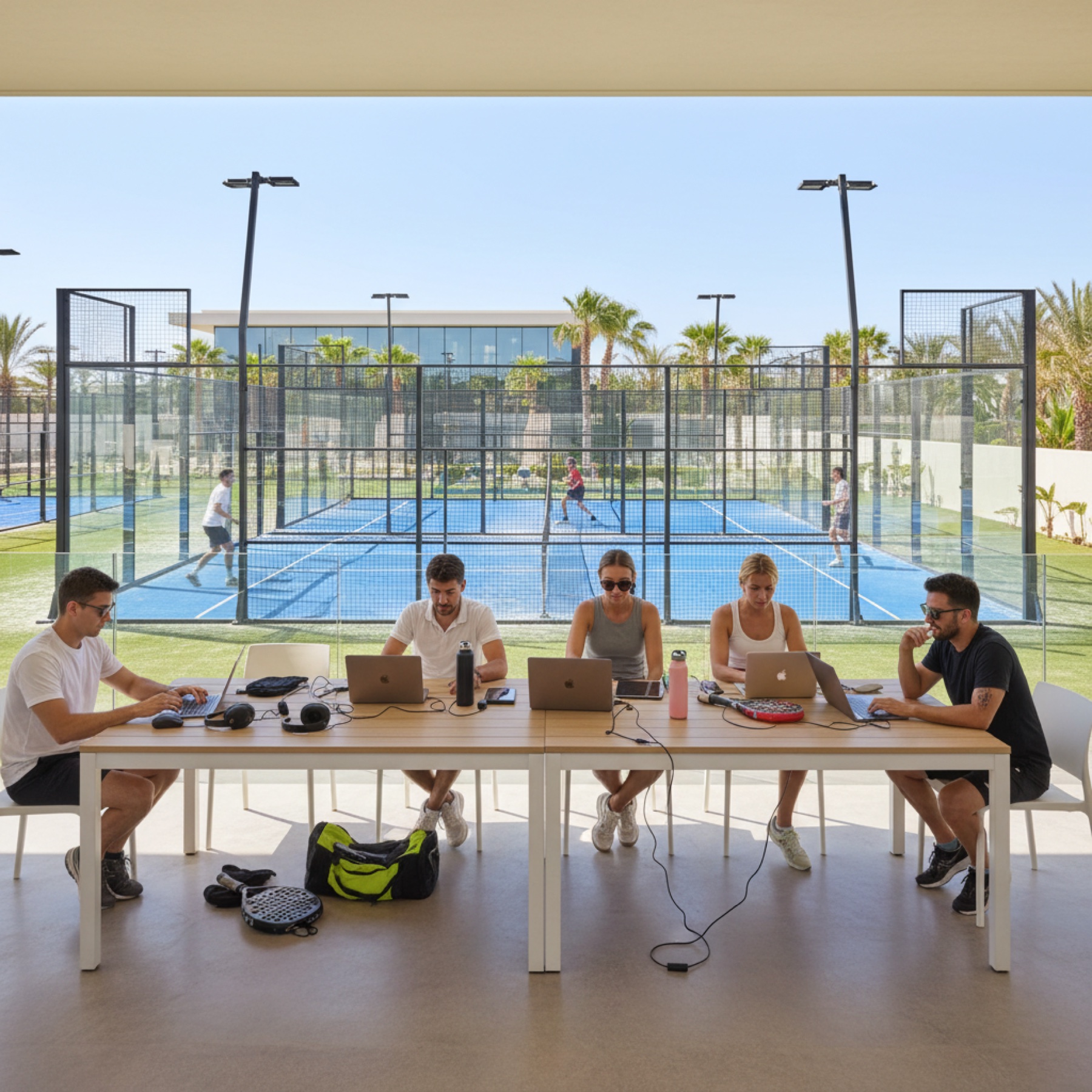
For employees planning a workation in another EU country, it's not just the most beautiful place that counts. Time zone, internet, accessibility, employer rules and everyday life that really work are important.
Workation quickly sounds like a sea view and a laptop on the terrace. For employees in Germany, something else counts in everyday life: stable video calls, a time zone that suits the team, realistic costs and as little friction as possible with A1, insurance and organization.
This guide summarizes the most important data from the TUI Workation Index 2025, Numbeo 2025, dem bunq Working Abroad Index 2025 and additional research on coworking offers. The aim is not wanderlust content, but rather a reliable basis for decision-making for Workations suitable for work within the EU.
Status: March 2025. A notice: All information is a guideline and does not replace individual legal, tax or insurance advice.
01Why the choice of destination is crucial
A Workation rarely fails due to motivation. It fails due to Wi-Fi that is too slow before the team call, a two-hour time difference in the wrong setup or accommodation that is intended for vacation but not for concentrated work.
European goals are often much more practical than long-term goals, especially for employees with a German work schedule. The reason is not just the proximity, but the combination Time zone proximity, infrastructure, accessibility and predictable costs.
02The 5 criteria that employees really need to pay attention to
- Internet quality and stability: For HD calls, upload and download should ideally deliver at least 20 to 30 Mbit/s, and significantly more for cloud work and backups.
- Time zone relative to Germany: One hour difference is usually manageable, two hours can significantly shift morning or evening appointments.
- Coworking as a backup: A reliable coworking space is the best insurance against failures, noise or unproductive accommodation.
- Real cost of living: Short-term rentals, day passes in coworking, flights and international health insurance make many seemingly cheap destinations significantly more expensive.
- A1 control risk and formalities: The A1 certificate is relevant for professional activity in other EU countries. The practical level of control varies depending on the country.
03Comparison: The best EU destinations at a glance
The following table summarizes the eleven destinations from the guide into the most important decision factors.
| Destination | TUI Score | Time zone | Internet | Coworking /100k | Rent 1 room | standard of living* | A1 risk |
|---|---|---|---|---|---|---|---|
| Lisbon | 71 | −1h | 155 Mbps | 23 | 1.392 € | 820 € | Moderate |
| Bucharest | 68 | ±0h | 236 Mbps | 4 | 570 € | 600 € | Small amount |
| Porto | 67 | −1h | 194 Mbps | 20 | 1.039 € | 750 € | Moderate |
| Barcelona | 66 | ±0h | 280 Mbps | 19 | 1.550 € | 950 € | Moderate |
| Las Palmas | 64 | −1h | 150 Mbps | 12 | 800 € | 720 € | Small amount |
| South Tyrol | 63 | ±0h | 200 Mbps | 8 | 1.200 € | 900 € | Medium |
| Madeira | 62 | −1h | 100 Mbps | 8 | 550 € | 620 € | Small amount |
| Valletta | 62 | ±0h | 200 Mbps | 14 | 1.050 € | 800 € | Small amount |
| Split | 60 | ±0h | 170 Mbps | 9 | 900 € | 700 € | Small amount |
| Athens | 60 | +1h | 120 Mbps | 10 | 700 € | 700 € | Small amount |
| Fuerteventura | 60 | −1h | 120 Mbps | 6 | 700 € | 680 € | Small amount |
- Cost of living without rent, as an estimate for Workationers.
04The strongest destinations in detail
04Lisbon and Porto: Infrastructure beats almost everything
Portugal is the reference case for many employees. Lisbon delivers a top value in the TUI Workation Index 2025, a strong coworking density and a well-established remote work community. Porto is often the more sensible alternative: faster internet, a little less pressure on the rental market and continued good infrastructure.
- Ideal for: Teams with a high call density, a clear routine and a desire for reliable backup.
- Strengthen: Coworking, community, climate, direct flights, easy planning.
- Trade off: Portugal is one hour behind Germany.
04Barcelona: Maximum urbanity, maximum costs
Barcelona is particularly attractive for employees who don't want a time difference and prefer an urban setup. Fiber optics, a strong coworking scene and a well-established remote ecosystem clearly speak for the city. At the same time, accommodation and everyday life are noticeably more expensive than in Portugal or Greece.
- Ideal for: Employees with a lot of meetings and a high preference for big city structure.
- Strengthen: ±0h time zone, excellent infrastructure, lots of choice.
- Trade off: High rents and overall expensive setup.
04Las Palmas, Fuerteventura and Madeira: Strong for winter and focus
If you want to get out in the German winter, you will get one of the most pleasant combinations of climate, accessibility and EU framework on the Atlantic islands. Las Palmas is the most urban nomad spot, Fuerteventura is the quieter alternative, Madeira scores with cheaper entry and a focus atmosphere.
- Ideal for: 2 to 6 weeks with a focus on climate, concentration and suitability for everyday use.
- Strengthen: Lower A1 control risk, good prices, relaxed rhythm.
- Trade off: Less big city infrastructure than Barcelona or Lisbon.
04South Tyrol, Split and Valletta: Practical middle ground
These goals are particularly interesting for employees who want to keep a simple time zone, short travel distances or language barriers low. South Tyrol scores with its German-speaking environment, Split with its good off-season economy, Valletta with English in everyday life and a compact island size.
04Athens and Bucharest: price-performance with clear logic
Athens and Bucharest are interesting if the budget is limited but the infrastructure still needs to be good. Bucharest is particularly notable for its very high internet speeds and low rental prices. Athens has a strong climate, but is a bit more planning-intensive due to the hour head start.
05Time zone: What does this mean in everyday working life?
| Time zone | Examples | Your 9 a.m. meeting in Germany is local at |
|---|---|---|
| ±0h | Barcelona, South Tyrol, Split, Malta, Bucharest | 9:00 a.m |
| −1h | Lisbon, Porto, Madeira, Las Palmas, Fuerteventura | 8:00 a.m |
| +1h | Athens, Crete, Corfu, Cyprus | 10:00 a.m |
For many employees, this point is crucial: If you regularly have to be at Daily at 9 a.m., the day in Portugal actually starts earlier. In Greece, afternoons and late meetings are pushed more back.
06Cost reality check: What a Workation really costs
Comparative indices work with local market values. However, for an actual Workation of two to six weeks, there are almost always surcharges:
| Cost item | Index value | Real Workation price | Typical effect |
|---|---|---|---|
| Accommodation | 1.000–1.400 € | 1.400–2.000 € | +30 to 50% |
| Co-working | approx. 150 € / month | €300-500 via day passes | +100 to 200% |
| International health insurance | not included | 60–150 € | additionally |
| Flight there and back | not included | 100–300 € | additionally |
The most important consequence: A seemingly cheap destination only remains cheap if accommodation and work setup are realistically calculated.
07Sample calculation: One month of Lisbon
Individual, 28 calendar days, 20 working days. All values are guidelines.
| position | minimum | maximum |
|---|---|---|
| Accommodation (furnished, central) | 1.400 € | 2.000 € |
| Coworking for 20 days | 300 € | 500 € |
| Flight there and back | 100 € | 300 € |
| International health insurance | 56 € | 140 € |
| Food, everyday life, public transport | 600 € | 900 € |
| Miscellaneous | 100 € | 200 € |
| In total | 2.556 € | 4.040 € |
According to the guide, there are roughly cheaper alternatives Madeira €1,800-2,800, Athens €1,700-2,600 and Bucharest €1,500-2,200.
08Conclusion: Which destination suits which working mode?
- For maximum infrastructure: Lisbon, Porto, Barcelona.
- For best value for money: Bucharest, Athens, Madeira.
- For winter Workation with a lot of everyday suitability: Las Palmas, Fuerteventura, Madeira.
- For easy collaboration without time differences: Barcelona, South Tyrol, Split, Valletta, Bucharest.
If you are an employee in Germany looking for a safe standard recommendation, see below Portugal hardly any way past. When simultaneity and meeting convenience are more important than community and Atlantic feeling, that is Barcelona usually the better choice. For cost-conscious setups with very good internet remains Bucharest the surprisingly strong candidate.
If you're looking for a curated setup instead of individual planning, you can find it at Elevation Workation formats a framework with a focus on sports, community and accommodation.
09FAQ on Workation for employees in other EU countries
09Which EU destination is easiest for employees in Germany?
Destinations with the same time zone, good infrastructure and low organizational friction are particularly practical. These include Barcelona, South Tyrol, Split, Malta and Bucharest. Despite −1 hour, Portugal remains the most popular option for many because the infrastructure and community are very strong.
09Do I really need an A1 certificate for a one-week Workation?
The A1 certificate is fundamentally relevant for professional activity in other EU countries, regardless of the duration. The guide expressly points out that the formal obligation is not tied to several weeks.
09Barcelona or Lisbon: which is better?
Barcelona scores with an identical time zone and a very strong urban infrastructure. Lisbon is often a little more pleasant in the overall feel of the Workation and has a very dense remote work community, but requires the adjustment to −1 hour.
09Which destination is the cheapest?
For low overall costs, Madeira, Athens and especially Bucharest are strong. Bucharest combines very fast internet values with comparatively low rents.
09What else do I need to clarify besides the destination?
At least relevant are the written consent of the employer, A1, international health insurance, VPN and IT issues as well as a clear additional agreement if your company only allows remote work abroad under certain conditions.
10Sources and data basis
- TUI Workation Index 2025
- Numbeo Cost of Living Index 2025
- bunq Working Abroad Index 2025
- coworker.com – Coworking spaces and daily prices
- PwC Germany – Mobile working in Germany 2024
- Appinio Travel Report 2024
Legal notice: This article is intended to provide general information and does not replace individual legal, tax or insurance advice.